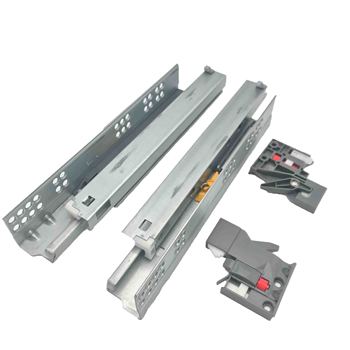
In high-end architectural millwork and contemporary frameless cabinetry, soft close undermount drawer slides have superseded traditional side-mount ball bearing tracks. Unlike side runners that expose cold-rolled steel channels and lubricating grease upon opening, concealed undermount slides mount beneath the wooden or composite drawer box. This hidden configuration preserves pristine timber dovetails, maximizes horizontal drawer storage volume, and isolates moving bearings from domestic airborne debris, kitchen grease, and wood particulate.
However, from an OEM procurement perspective, selecting the correct runner involves precise tolerances. Undermount hardware relies on an exact kinematic interaction between the cabinet interior carcass width, the drawer bottom recess depth (sub-bottom clearance, typically 12 mm to 15 mm), and the drawer box side thickness. A standard slide engineered for 16 mm (5/8") side panels will experience internal resistance and binding if paired with North American 19 mm (3/4") solid timber boxes. Xiamen Vock Hardware Co., Ltd. resolves this global sizing dilemma by manufacturing dedicated stamped channels configured specifically for 16 mm and 18/19 mm side panels across standard fractional inch (12", 14", 16", 18", 20", 21", 24") and metric (300 mm to 600 mm) configurations.
Concealed Kinematics: Fluid Damping vs. Friction-Spring Trapping
The core mechanism that differentiates high-performance soft-closing drawer tracks is the fluid damping piston assembly. Early-generation soft-closing runners suffered from harsh initial opening resistance ("drawer jerk") followed by insufficient retraction force that left heavily loaded drawers slightly ajar. Modern Vock undermount slides integrate dual-action progressive tension springs synchronized with sealed, high-viscosity silicone fluid dampers. When extended, the integrated trigger pin smoothly primes the tension mechanism with low pull-out force (< 20 N). Upon closing, the hydraulic piston engages at 45 mm before full closure, decelerating the drawer momentum softly and drawing the drawer front flush against the cabinet frame at a sound level below 35 dB.